
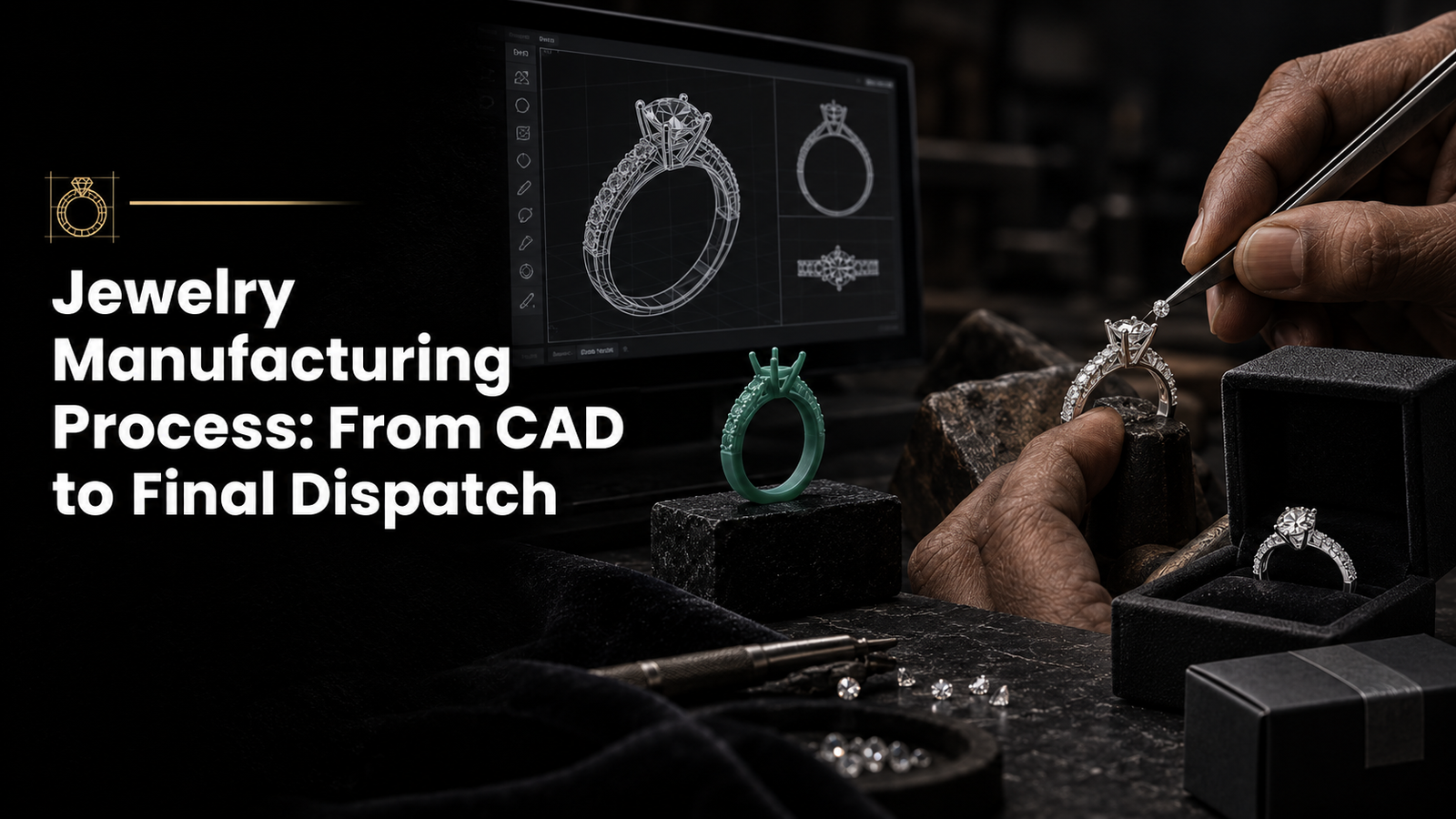
Discover how jewelry moves from CAD design to final dispatch through a structured manufacturing process. Learn the key production stages and quality checks that help ensure consistent, high-quality results.
The Risk Hiding Behind an Approved Sample
Here is a situation most jewelry retailers recognize. You approve a beautiful sample ring, place a bulk order of 200 pieces, and plan a collection launch around the delivery date. When the shipment arrives, the rings weigh 7 percent more than quoted, a handful of pavé stones loosen within the first week of sales, and your per-piece margin quietly disappears into extra gold cost and customer returns. Nothing about the sample predicted this. The problem was never the design. It was the jewelry manufacturing process behind it, and the fact that nobody examined how the manufacturer works before the purchase order was signed.
This guide walks through the complete jewelry manufacturing process from CAD design to final dispatch, but from a buyer’s point of view. At every stage, it covers what actually happens on the production floor, where things commonly go wrong, and what retailers, wholesalers, and brands should verify before committing to a manufacturing partner.
Why the Manufacturing Process Matters to Buyers
For a buyer, the manufacturing process is not technically detailed. It is the single biggest driver of the five things that decide whether a jewelry business makes money.
Production consistency comes first. A retailer selling a 50-piece collection needs piece number 50 to match piece number 1 in weight, finish, and stone quality. That only Happens When the manufacturer works from documented specifications and reference masters rather than from memory. Cost and margins follow directly, because gold and silver are priced by the gram. A jewelry production process without weight control can push a piece 5 to 10 percent over the quoted weight, and at current gold prices that difference alone can erase a retail margin. Delivery timelines depend on how failures are handled inside the factory. A porous casting that must be redone, or a CAD file that turns out to be unmanufacturable, adds one to two weeks that the buyer usually discovers only after the deadline slips. Product quality determines returns and repairs, and every returned piece costs more than its production value once shipping, refinishing, and customer handling are counted. Finally, customer trust sits on top of all of it. A retailer’s brand absorbs the blame for a stone that falls out, not the factory that sets it. Choosing a manufacturer is therefore a decision about your own reputation.
The Complete Jewelry Manufacturing Process at a Glance
Before examining each stage in depth, it helps to see the full jewelry-making process step by step in one view:
Requirement → CAD → Prototype → Casting → Stone Setting → Finishing → Quality Check → Dispatch
| Stage | What Happens Here |
| Requirement | Order specifications are documented: metal, purity, stone details, target weight, quantity, and deadline |
| CAD | The design becomes a precise 3D model with exact dimensions and an estimated metal weight |
| Prototype | A 3D printed resin or wax model is produced and approved before any metal is used |
| Casting | The approved model is converted into gold, silver, or platinum through investment casting |
| Stone Setting | Skilled setters secure diamonds and gemstones using prong, pave, bezel, or channel techniques |
| Finishing | The piece is filed, polished, textured, or rhodium plated to match the approved sample |
| Quality Check | Purity, weight, stone security, dimensions, and finish are verified against the order sheet |
| Dispatch | Final approval, secure packaging, documentation, and insured shipping to the buyer |
Each of these stages has its own failure modes, and each provides the buyer with something specific to verify. The next section goes through them one by one.
The Jewelry Production Process, Stage by Stage
Stage 1: Requirement and Specification
What happens: The manufacturer converts the buyer’s brief into a written specification: metal and purity, stone type, size and clarity grade, target gross weight with tolerance, quantity, finish reference, and delivery date.
What can go wrong: Vague briefs are the most expensive documents in this industry. When purity, stone grade, or weight tolerance is left to assumption, the disagreement surfaces after casting. When correcting, it means remaking the piece.
What the buyer should check: Insist on a signed specification sheet before design work begins. If a manufacturer is willing to start production from a WhatsApp message and a photo, treat that as a warning sign, not as flexibility.
How D’vins manages it: No order enters the D’vins design queue without a confirmed requirement sheet covering metal, purity, stone specifications, weight tolerance, and timeline, signed off by the client. This document serves as the reference for all subsequent quality checks.
Stage 2: CAD Jewelry Design Process
What happens: The CAD jewelry design process turns the concept into a dimensioned 3D model. The software calculates exact measurements, prong sizes, wall thickness, and a projected metal weight, and produces renders the client can review from every angle.
What can go wrong: A model can look flawless on screen and still be unmanufacturable. Walls drawn too thin collapse in casting, undersized prongs cannot hold stones securely, and an optimistic weight estimate in CAD becomes a costing dispute at delivery.
What the buyer should check: Ask for the estimated gross weight along with the render and ask who reviews the CAD file for manufacturability before it is approved. A designer’s approval and a production team’s approval are not the same thing.
How D’vins manages it: Every CAD file at D’vins passes a manufacturability review by the production team, which checks minimum wall thickness, prong dimensions, and stone seat depths before the client sees the render. The projected weight is shared with the design team, so there are no surprises at invoicing.
Stage 3: Prototype Development
What happens: The approved CAD file is 3D printed in castable resin or wax. This physical prototype confirms scale, proportion, and wearability before any precious metal is committed.
What can go wrong: The common failure here is skipping the stage entirely to save two or three days. A sizing or proportion error found at the wax stage costs almost nothing to fix. The same error was found after casting costs of metal, labor, and a week of rework.
What the buyer should check: Confirm that a prototype approval step exists for every new design and ask to see photographs or receive the model itself before authorizing casting, especially bulk orders.
How D’vins manages it: D’vins prints a prototype for every new design and holds production until it is approved. For repeat orders, the approved model is archived as a reference master, so future batches are built against the same physical standard.
Stage 4: Casting
What happens: Wax models are mounted on a central stem to form a tree, invested in plaster, and burned out in a furnace. Molten gold, silver, or platinum is then vacuum cast into the cavity. Alloy composition and temperature control decide the outcome.
What can go wrong: Porosity, incomplete filling, and off-color alloys are the classic casting defects. A porous piece that is patched and polished over instead of re-cast will pass a glance today and crack at the setting stage or, worse, in the customer’s hands.
What the buyer should check: Ask how the manufacturer sources and tests its alloys, whether purity is verified before and after casting, and what the policy is for defective castings. The answer you want to hear is re-cast, not repair.
How D’vins manages it: D’vins tests alloy purity before melting and inspects every casting under magnification once it is cleaned. Pieces showing porosity or incomplete fill are re-cast rather than patched, and the metal is recovered and refined, so the defect never travels forward in the process.
Stage 5: Stone Setting
What happens: Setters secure each stone using the technique the design demands: prong settings for solitaires, pave for surfaces covered in melee, bezel for daily-wear durability, and channel for bands. This is the most skill-dependent stage of the entire process.
What can go wrong: Loose stones are the single most common jewelry complaint worldwide. Chipped melee during setting, uneven pave rows, and prongs polished too thin are the defects that surface weeks after delivery, on the customer’s finger rather than the factory bench.
What the buyer should check: Ask how stone security is tested after setting. A serious manufacturer can describe its method, whether probe testing each stone, controlled tapping, or ultrasonic checks, and can state its policy on stones chipped during setting.
How D’vins manages it: After setting, every D’vins piece goes through an individual stone-security check in which each stone is probe-tested. Stones chipped in setting are replaced immediately at the factory’s cost, and the piece re-enters inspection before it is allowed to move to finishing.
Stage 6: Finishing and Polishing
What happens: The piece is filed, pre-polished, and taken through successive buffing stages. Depending on the design, the finisher applies high polish, matte, or textured surfaces, and white gold typically receives rhodium plating.
What can go wrong: Over-polishing removes metal, which softens design details and pulls the piece below its quoted weight. Across a batch, inconsistent finishing is what makes a collection look cheap on a display tray even when every individual piece seems acceptable alone.
What the buyer should check: Ask whether finished pieces are compared against an approved master sample, and whether weight is re-verified after polishing. For collections, ask to see several pieces from one batch side by side before dispatching.
How D’vins manages it: D’vins finishers work against the archived master sample under standardized lighting, and every piece is re-weighed after polishing to confirm it remains within the tolerance agreed on the requirement sheet
Stage 7: Quality Check
What happens: Inspectors verify metal purity, gross and net weight, dimensions, stone count and security, and finish quality against the original specification before the order is cleared for packing.
What can go wrong: The structural weakness in many factories is a single inspection at the end of the line. By then, a defect introduced at casting has already absorbed setting and finishing labor, which creates quiet pressure to wave marginal pieces through.
What the buyer should check: Ask whether quality control happens in stages or only at the end, and whether the manufacturer can share a QC report with each order. The existence of a written, per-order checklist says more than any certificate on the wall.
How D’vins manages it: D’vins inspects four fixed points: after casting, after stone setting, after finishing, and before dispatching. Each order carries a recorded checklist through all four gates, and a piece that fails against any gate returns to the previous stage rather than continuing forward.
Stage 8: Dispatch
What happens: Approved pieces are cleaned, sealed in tamper-evident packaging, cushioned against transit movement, and shipped with invoices, certifications, and, for export orders, the customs documentation the destination country requires.
What can go wrong: Transit damage and documentation errors are the two failure points. For export orders, an incomplete customs file can hold a shipment for weeks, which for a seasonal collection is commercially the same as losing it.
What the buyer should check: Confirm packaging methods, transit insurance, and, if you import, the manufacturer’s actual export documentation experience with your destination market. Ask for their record on on-time dispatch, not just their promised lead time.
How D’vins manages it: D’vins dispatches through insured, trackable logistics with order-wise documentation prepared in parallel with final QC, so paperwork never becomes the reason a completed order sits in the factory. Clients receive dispatch confirmation while tracking the day of shipment.
Where Jewelry Production Commonly Fails
Across the industry, most disputes between buyers and manufacturers trace back to a small set of recurring failures, and it is worth understanding why each one happens.
Unmanufacturable CAD designs: These occur when design and production teams do not talk to each other. The buyer pays for the gap in redone models and lost weeks.
Loose stones: These are almost always a process failure rather than bad luck: no individual stone testing after setting, or prongs weakened during polishing. The buyer pays in return and reputation.
Weight variation: This comes from casting inconsistency and uncontrolled polishing. Because precious metal is the largest cost component, a few percent of drift multiplied across a bulk order is a direct hit to margin.
Finishing inconsistency: This appears when there is no master sample to finish against. Individual pieces pass, but the collection does not match.
Sample-to-bulk mismatch: This is the most damaging failure for retailers. It happens when a factory makes samples in a dedicated skilled cell but runs bulk through a different line with different standards. Always ask who actually produces the bulk order.
Delayed approvals: Delays cut both ways. Manufacturers lose time waiting on buyer sign-offs, and buyers lose launch dates when factories sit on queries. A defined approval turnaround on both sides belongs in the purchase agreement, not in goodwill.
Custom and Bulk Jewelry Manufacturing: Different Workflows, Different Risks
A common buyer mistake is assuming one factory process fits every order type. In practice, the custom jewelry manufacturing process and bulk production place very different demands on planning, quality control, and communication.
A single custom design: This is approval-heavy and communication-heavy. The workflow runs consultation, CAD, prototype, production, and final review, with the client involved at each checkpoint. Timelines depend more on decision speed than on factory speed, and the manufacturer’s job is to make each approval point clear and fast.
Retailer collections: Collections shift the weight toward planning. Twenty designs in three metal colors and five sizes is a matrix of hundreds of variants, so the factory needs structured order sheets, batch tracking, and finishing standards that hold across the whole range, not just within one piece.
Repeat production: Repeat orders to test a manufacturer’s memory. Without archived CAD files, master samples, and recorded specifications, the second batch is a reinvention rather than a repetition, and buyers see it in weight and finish drift between orders.
Export orders: Exports add compliance on top of production: hallmarking rules of the destination market, certification for stones, customs documentation, and packaging that survives international transit. Here, the jewelry manufacturing process in India has matured considerably, with hubs such as Mumbai, Jaipur, and Surat combining traditional artisan skill with CAD studios, organized production systems, and export-grade quality documentation. It is a large part of why international brands source from Indian manufacturers, but the buyer still has to verify that a specific factory, not the industry in general, has the systems these orders demand.
How D’vins Runs Quality Control
Quality claims mean little without checkpoints attached, so here is the D’vins process in concrete terms. Incoming metal and stones are verified against the order specification before production begins. Every CAD file clears a production-team manufacturability review before client approval. New designs require an approved prototype, which is then archived as the master reference. After casting, each piece is inspected under magnification, and defective castings are re-cast, not repaired. After setting up, every stone is individually probe-tested. After finishing, pieces are compared against the master sample and re-weighed to confirm they sit within the agreed tolerance. Before dispatching, a final audit reconciles the physical order against the requirement sheet, covering purity, weight, stone count, finish, and documentation. Each order travels with its recorded checklist, which means a buyer asking why a batch was delayed or how a defect was caught gets an answer from records rather than recollection.
Buyer Checklist: Questions to Ask Before Choosing a Jewelry Manufacturer
Use this list in your first serious conversation with any prospective manufacturing partner. The answers will tell you more than a factory tour.
- Do you work from a signed specification sheet before starting CAD, and can I see a sample of one?
- Who reviews CAD files for manufacturability before client approval: designers or the production team?
- Is a prototype produced and approved for every new design before casting?
- How do you test metal purity, and is it verified before and after casting?
- What is your policy on porous or defective castings: re-cast or repair?
- How is stone security tested after setting, and who bears the cost of stones chipped during production?
- Are finished pieces compared against an archived master sample, and are weights re-verified after polishing?
- Is quality control staged through production or performed only at the end, and do orders ship with a QC report?
- Who produces bulk orders: the same team that made my sample, or a separate line?
- What weight tolerance do you commit to in writing, and how are overages handled commercially?
- What is your actual on-time dispatch record, and how are transit insurance and export documentation handled?
- What approval turnaround do you commit to on your side, and what do you expect from mine?
A manufacturer with real systems will answer these quickly and specifically. Hesitation, vagueness, or offense at the questions is itself useful information.
Conclusion: Choose the Process, Not Just the Sample
A sample shows you what a manufacturer can do once. The jewelry manufacturing process behind it decides what you will receive on piece 200 of a bulk order, on the third repeat batch, and on the export shipment that must clear customs before your season starts. Buyers who understand the journey from requirement sheet to CAD, prototype, casting, setting, finishing, staged quality checks, and dispatch are equipped to ask the questions that separate disciplined factories from lucky ones.
If you are a jewelry retailer, wholesaler, or brand evaluating manufacturing partners, D’vins is glad to walk you through each of these stages in practice, including the requirement sheets, QC checklists, and the master-sample system described above, and to discuss how your specific designs and order volumes would move through them. Share your requirements with the D’vins team and put this process into your next collection.
Frequently Asked Questions
The process moves through requirement documentation, CAD design, prototype development, casting, stone setting, finishing, staged quality checks, and finally packaging and dispatch. Each stage has its own inspection point before the piece moves forward.
CAD converts a design into an exact 3D model with precise dimensions and a projected metal weight before production begins. It allows quick revisions, client approval in advance, and manufacturability review, which together reduce errors, disputes, and material wastage.
3D printing converts the approved CAD file into a physical resin or wax model used for casting. It gives the buyer a real prototype to approve before any precious metal is committed, so sizing or proportion errors are caught while they are still cheap to fix.
A standard piece usually takes two to four weeks from approved CAD to dispatch. Complex custom designs and bulk collections can take six weeks or more, depending on approval speed, stone sourcing, and finishing requirements.
Handmade jewelry is shaped entirely by hand, which gives individuality but makes exact repetition across a batch difficult. CAD-based manufacturing delivers precision and consistency from piece to piece, and most professional units today combine both, using CAD for accuracy and artisans for setting and finishing.
It starts with a detailed consultation and a written specification, moves through personalized design and CAD approval, and then follows the regular production stages with the client reviewing progress at defined checkpoints before final approval and dispatch.
India combines skilled artisans, established CAD and casting infrastructure, competitive pricing, and deep export experience across hubs such as Mumbai, Jaipur, and Surat. For buyers, that means handcrafted detail backed by organized production systems, provided the specific factory processes are verified before ordering.