
A jewelry business may have growing demand, successful collections, and opportunities in new markets, yet producing more without affecting quality, consistency, or delivery schedules can become difficult. At this stage, working with a regular supplier may no longer be enough. Established businesses need repeatable processes, technical control, and dependable production coordination.
OEM jewelry manufacturing provides a practical solution for brands that want to expand production without managing every manufacturing activity internally. The right manufacturing partner can support higher order volumes, repeat production, new collection development, quality control, and international fulfilment while following the brand’s product specifications.
What Is OEM Jewelry Manufacturing?
OEM stands for original equipment manufacturing. In the jewelry industry, it generally refers to an arrangement in which a brand provides its product requirements and an OEM jewelry manufacturer produces the jewelry according to those specifications. The requirements may include the design, metal type, stone specifications, dimensions, estimated weight, finish, order quantity, packaging, and delivery expectations.
The typical relationship follows this structure:
Brand Requirements → OEM Manufacturer → Production → Quality Inspection → Brand-Ready Jewelry
The brand controls its product direction, positioning, and approvals. The jewelry OEM manufacturer converts those requirements into a production-ready process. OEM arrangements can vary. Some OEM jewelry manufacturing services cover everything from CAD development and sampling to manufacturing, packaging, and dispatch. Others may support only specific production stages. The exact responsibilities should always be defined in the commercial agreement.
OEM vs ODM vs Private-Label Jewelry Manufacturing
| Factor | OEM Manufacturing | ODM Manufacturing | Private Label |
|---|---|---|---|
| Product concept | Brand-led | Manufacturer-led or collaborative | Existing or developed designs |
| Specifications | Brand specifications | Depends on the agreement | Varies |
| Customisation | Usually high | Varies | Moderate to high |
| Production | Manufacturer | Manufacturer | Manufacturer or supplier |
| Design ownership | Contract-dependent | Contract-dependent | Contract-dependent |
| Best suited to | Established brands | Brands seeking development support | Emerging and established brands |
Why Global Jewelry Brands Choose OEM Manufacturing
Global brands often choose OEM jewelry manufacturing to expand their production capacity without investing in an entire manufacturing facility. They can use the manufacturer’s established infrastructure, technical team, production workflows, and sourcing network. OEM production can also improve efficiency. Instead of coordinating CAD development, casting, diamond setting, polishing, inspection, and dispatch through different vendors, the brand can work with one jewelry production partner.
Consistency is another major consideration. Established brands frequently need replenishment of successful SKUs. Approved specifications, production records, and master samples help the manufacturer reproduce designs more accurately.
A capable manufacturing partner can also support category expansion. A brand may introduce new rings, earrings, bracelets, necklaces, or customized collections without building separate internal production teams. For international growth, the manufacturer may assist with packaging, documentation, certification requirements, and shipping coordination. However, production capacity and delivery schedules should always be verified for each order.
How OEM Jewelry Manufacturing Works
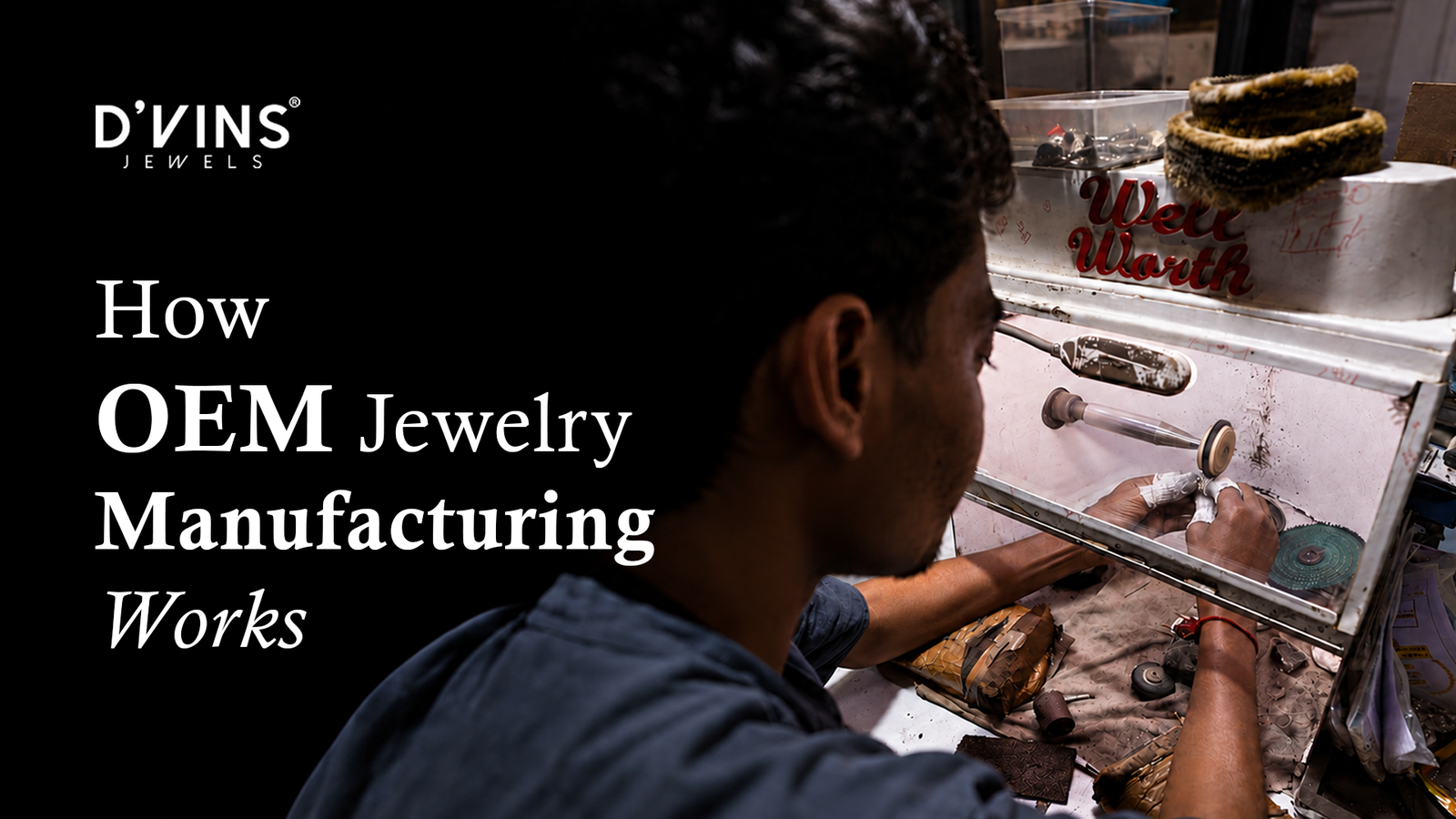
The jewelry manufacturing process commonly follows this sequence:
Brand Requirements → Design/CAD → Prototype → Material Approval → Production → Diamond Setting → Finishing → Quality Check → Packaging → Dispatch
Production can begin with an existing CAD file, physical sample, sketch, reference image, or new product concept. For repeat and bulk jewelry manufacturing, approved specifications and reference samples become especially important because they reduce interpretation between different production batches.
The OEM Jewelry Manufacturing Process: Stage by Stage
Stage 1: Understanding Brand Requirements
What Happens: The manufacturer records the product design, metal type, diamond requirements, quantity, delivery expectations, and packaging instructions.
What Can Go Wrong: Incomplete specifications may create confusion regarding dimensions, weight, finish, or stone quality.
What the Brand Should Check: Approve a written product specification and establish who is responsible for approvals.
How D’vins Manages It: D’vins begins its custom manufacturing workflow by understanding the buyer’s design and production requirements before development begins.
Stage 2: CAD Design and Technical Development
What Happens: The design is converted into a technical CAD model suitable for production.
What Can Go Wrong: A visually appealing concept may have impractical dimensions, weak construction, or unsuitable stone placement.
What the Brand Should Check: Review dimensions, estimated metal weight, stone layout, proportions, and construction details.
How D’vins Manages It: D’vins develops CAD models from sketches, reference images, physical samples, CAD files, and product concepts.
Stage 3: Prototype and Sample Approval
What Happens: A prototype or sample is produced to evaluate the design before larger production begins.
What Can Go Wrong: Moving directly into bulk production can multiply an unnoticed design or finishing issue across the entire order.
What the Brand Should Check: Compare the sample with the approved specifications and record every requested revision.
How D’vins Manages It: Its process includes wax development and sampling, allowing buyers to review a design before confirming larger production requirements.
Stage 4: Material and Diamond Selection
What Happens: Metal and diamonds are selected according to the approved order specifications.
What Can Go Wrong: Variations in metal weight, diamond size, colour, clarity, or certification can affect consistency and cost.
What the Brand Should Check: Confirm material standards, diamond requirements, weight tolerances, and certification needs in writing.
How D’vins Manages It: D’vins works with natural and lab-grown diamonds and offers recognised diamond-grading options based on order requirements.
Stage 5: Casting and Manufacturing
What Happens: The approved model proceeds to casting, filing, and structural preparation.
What Can Go Wrong: Porosity, shrinkage, inaccurate dimensions, or weight variation may cause a mismatch between the approved sample and bulk pieces.
What the Brand Should Check: Define acceptable dimensional and weight tolerances before production.
How D’vins Manages It: Casting and filing are included in the company’s published in-house manufacturing process.
Stage 6: Diamond Setting
What Happens: Diamonds or gemstones are positioned and secured according to the approved layout.
What Can Go Wrong: Uneven alignment, inconsistent spacing, or weak stone security can affect the final product.
What the Brand Should Check: Inspect the stone count, alignment, spacing, setting security, and overall consistency.
How D’vins Manages It: Diamond and gemstone setting forms part of its in-house process, with attention given to alignment, balance, and consistency.
Stage 7: Finishing and Polishing
What Happens: Surfaces, edges, and design details are refined to achieve the approved finish.
What Can Go Wrong: Uneven or excessive polishing can alter design details, dimensions, or surface consistency.
What the Brand Should Check: Compare the finish, colour, texture, and design definition with the approved sample.
How D’vins Manages It: Pre-polishing, final polishing, ultrasonic cleaning, and preparation are handled as separate production stages.
Stage 8: Final Quality Inspection
What Happens: Finished jewelry is checked against the approved design and order specifications.
What Can Go Wrong: Small variations can multiply across a large order if they are not identified during production.
What the Brand Should Check: Ask for measurable inspection criteria, sample-to-bulk comparison, and a defined process for rejected pieces.
How D’vins Manages It: D’vins states that each finished piece is inspected against the approved design and order requirements before dispatch.
Stage 9: Packaging and Dispatch
What Happens: Approved jewelry is cleaned, packed, documented, and prepared for delivery.
What Can Go Wrong: Unsuitable packaging, incorrect labelling, or incomplete export paperwork may delay or damage an order.
What the Brand Should Check: Confirm packaging standards, shipping responsibility, documentation, and dispatch details.
How D’vins Manages It: D’vins supports packaging requirements, export coordination, and global shipping for international buyers.
How OEM Manufacturing Helps Brands Scale Production
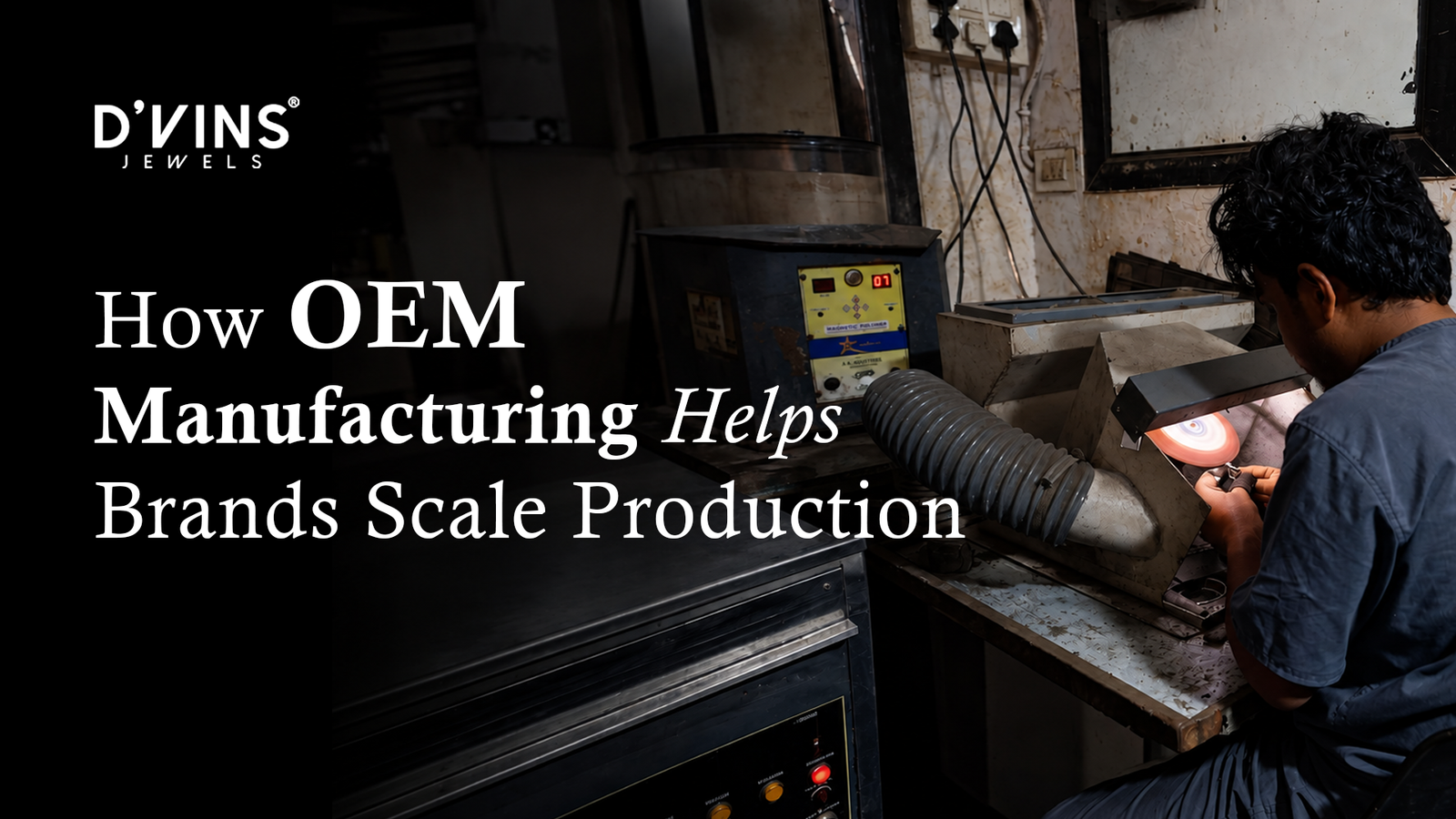
Scalable jewelry manufacturing depends on control, not only on production capacity. An experienced manufacturer can help a brand move from smaller production runs to larger recurring orders while maintaining approved specifications. Repeat production is particularly important for successful collections. Production records, CAD files, master samples, stone specifications, and finishing references help reduce variation when an older design is reordered.
OEM manufacturing also supports collection expansion. Brands can introduce new categories without managing every stage of technical development, sourcing, production, and inspection internally. Production planning connects order forecasts, material availability, approvals, manufacturing schedules, and dispatch targets. This gives both parties clearer visibility over responsibilities and potential delays.
Operational flexibility allows the manufacturer to support samples, test collections, repeat SKUs, and wholesale jewelry manufacturing requirements through an agreed workflow. As order volumes increase, quality control becomes more important. A minor inconsistency in one sample may become a serious commercial problem when repeated across hundreds of pieces.
Common Challenges When Scaling Jewelry Production
Sample-to-bulk mismatch, metal-weight variation, inconsistent diamond setting, uneven finishing, delayed approvals, and limited capacity are common production challenges. Poor communication can make older designs difficult to reproduce. Missing CAD files, incomplete specifications, or unrecorded sample changes may force both teams to repeat development work.
Quality problems can increase rework expenses, reduce margins, delay collection launches, and affect customer trust. International orders may face additional delays when packaging, certification, or export documents are not coordinated in advance. A manufacturer supporting established brands should therefore maintain clear approval stages, production records, quality checkpoints, and early reporting when a requirement cannot be met.
OEM Jewelry Manufacturing for Different Buyers
Established jewelry brands generally need consistent production, repeat orders, brand-specific specifications, and new collection development. Retail jewelry businesses may focus more on inventory planning, replenishment, product consistency, and expanding their available range. Wholesale jewelry businesses require bulk-order coordination, production efficiency, consistency across quantities, and dependable dispatch planning.
Global jewelry businesses also need packaging suited to their market, export documentation, shipping coordination, and clear communication across time zones. The manufacturing model should be adapted to the buyer’s requirements instead of forcing every business into the same production arrangement.
What to Look for in an OEM Jewelry Manufacturer
Brands should evaluate manufacturing experience, custom OEM jewelry manufacturing capabilities, in-house production, CAD and prototyping, diamond expertise, quality systems, realistic capacity, repeat-order support, and communication.
International buyers should also examine the manufacturer’s experience with shipping, certification requirements, packaging, and export documentation.
Price is important, but it should not be the only deciding factor. Rework, product rejection, delayed launches, and customer complaints can make the lowest manufacturing quote far more expensive over time.
Quality Control in OEM Jewelry Manufacturing
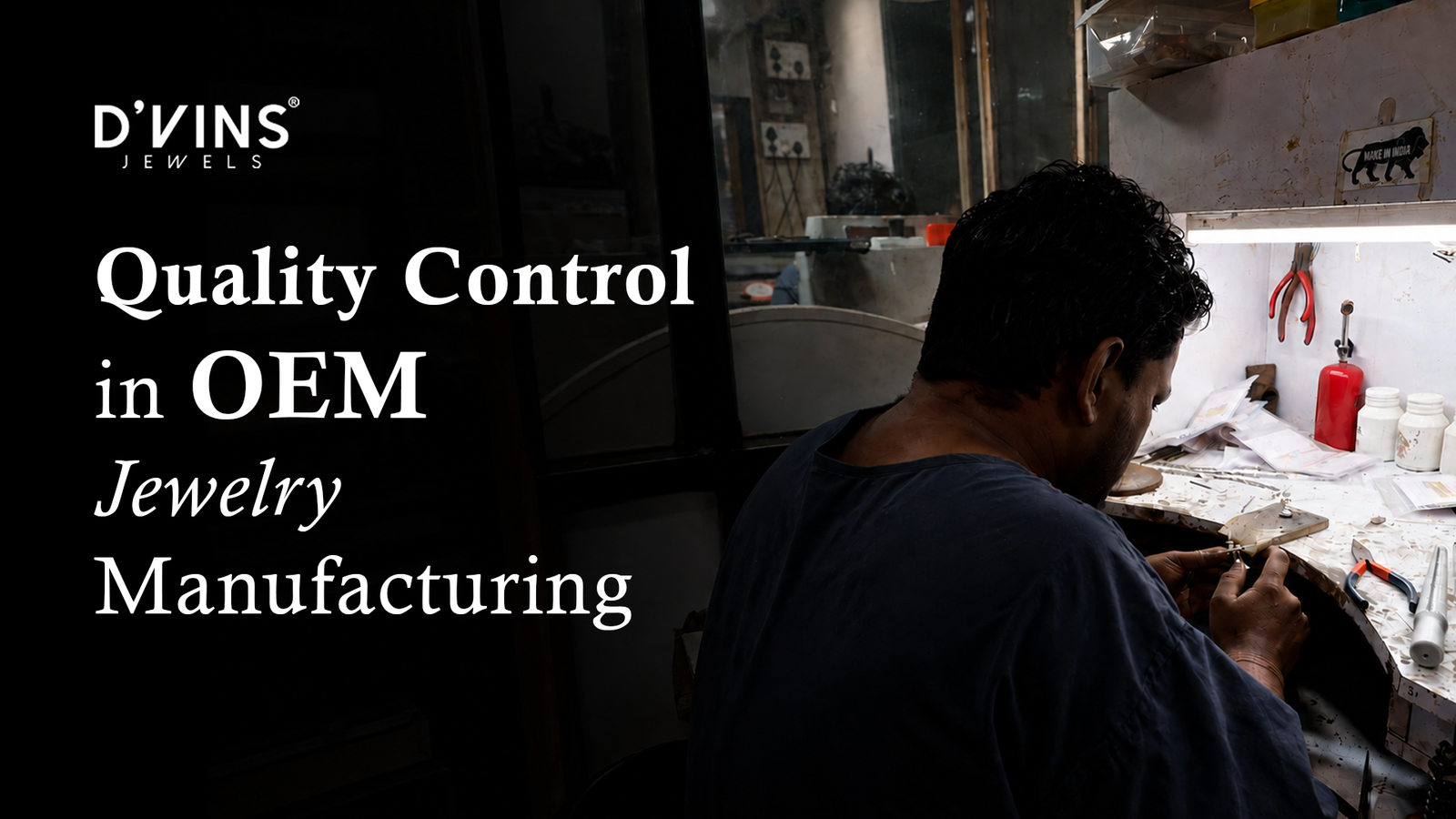
Quality control should begin before bulk production, not only after the order is finished. Important checkpoints include design verification, prototype approval, metal and weight checks, diamond inspection, setting review, finishing inspection, sample-to-bulk comparison, and final approval.
Established brands should ask how these checks are performed, measured, and documented. A general claim that every piece is checked does not explain what is inspected or what happens when a product falls outside the approved tolerance.
OEM Jewelry Manufacturing Costs and Production Considerations
Manufacturing costs are influenced by metal type and weight, diamond quality, design complexity, quantity, labour, finishing requirements, packaging, shipping, and customisation.
Buyers should also clarify minimum order quantities, sample charges, production lead times, repeat-order pricing, and how changes in metal or diamond prices are handled.
The lowest quote is not always the best choice for a growing jewelry business. It may exclude technical development, tighter quality tolerances, specialised packaging, documentation, or protection against rework.
How to Choose the Right OEM Jewelry Manufacturing Partner
Before committing a large order, brands should understand how the manufacturer translates design requirements into production instructions, controls quality across volume, manages delays, and supports recurring orders.
Request evidence relevant to your product category and target market. A practical evaluation can move from CAD development to a sample and then to a controlled first production batch. This tests the manufacturer’s craftsmanship, communication, documentation, and ability to follow approvals.
Why Consider D'vins for Brand-Specific Production?
D’vins is a Surat-based custom diamond jewelry manufacturer serving brands, retailers, wholesalers, distributors, and international buyers. Its published capabilities include end-to-end in-house production, CAD development, sampling, natural and lab-grown diamond jewelry, quality inspection, repeat-order support, and international fulfilment.
Because OEM is not currently presented as a formally named service on the D’vins website, buyers should confirm whether their required OEM structure, design ownership, confidentiality terms, and production agreement can be supported. However, its custom jewelry manufacturing capabilities make D’vins a relevant potential partner for established businesses seeking brand-specific jewelry production.
Buyer Checklist: Choosing an OEM Jewelry Manufacturer
Confirm whether the manufacturer can:
- Follow your designs and protect design ownership
- Maintain confidentiality
- Provide CAD development and sampling
- Manage production in-house
- Document quality checks
- Maintain consistency across bulk orders
- Support recurring orders
- Meet practical capacity requirements
- Explain minimum order quantities and lead times
- Manage defective pieces
- Support international shipping
- Define payment terms
- Provide relevant certifications and documentation
Conclusion
OEM jewelry manufacturing can help established jewelry businesses scale production while maintaining greater control over product specifications, quality, and brand requirements. The right manufacturing partner should provide more than production volume. It should contribute reliable workflows, technical knowledge, consistent quality, production flexibility, and long-term repeatability.
D’vins can potentially support established jewelry brands, retailers, wholesalers, and global businesses through its custom development and in-house manufacturing capabilities. Discuss your OEM jewelry manufacturing requirements, expected production volumes, target market, and upcoming collections with D’vins to identify the most suitable production approach.
Frequently Asked Questions
OEM jewelry manufacturing is an arrangement in which a manufacturer produces jewelry according to a brand’s approved designs, specifications, and commercial requirements.
The brand provides its requirements, and the manufacturer develops or validates the technical files, creates samples, completes production, conducts quality checks, and prepares the order for dispatch.
OEM production is generally based on detailed brand-led specifications. Private-label production may use existing, adapted, or jointly developed designs. Exact rights and responsibilities depend on the agreement.
OEM manufacturing can provide additional production capacity, better repeatability, product-category expansion, and reduced internal manufacturing complexity.
Costs depend on metal, weight, diamond specifications, design complexity, quantity, labour, finishing, sampling, packaging, customisation, and shipping.
Look for relevant manufacturing experience, technical development, in-house capabilities, measurable quality controls, realistic capacity, transparent communication, and repeat-order support.
Yes, provided the manufacturer’s production capacity, sourcing, planning, documentation, and quality systems match the required order volumes. Brands should verify these capabilities through sampling and a controlled first batch.