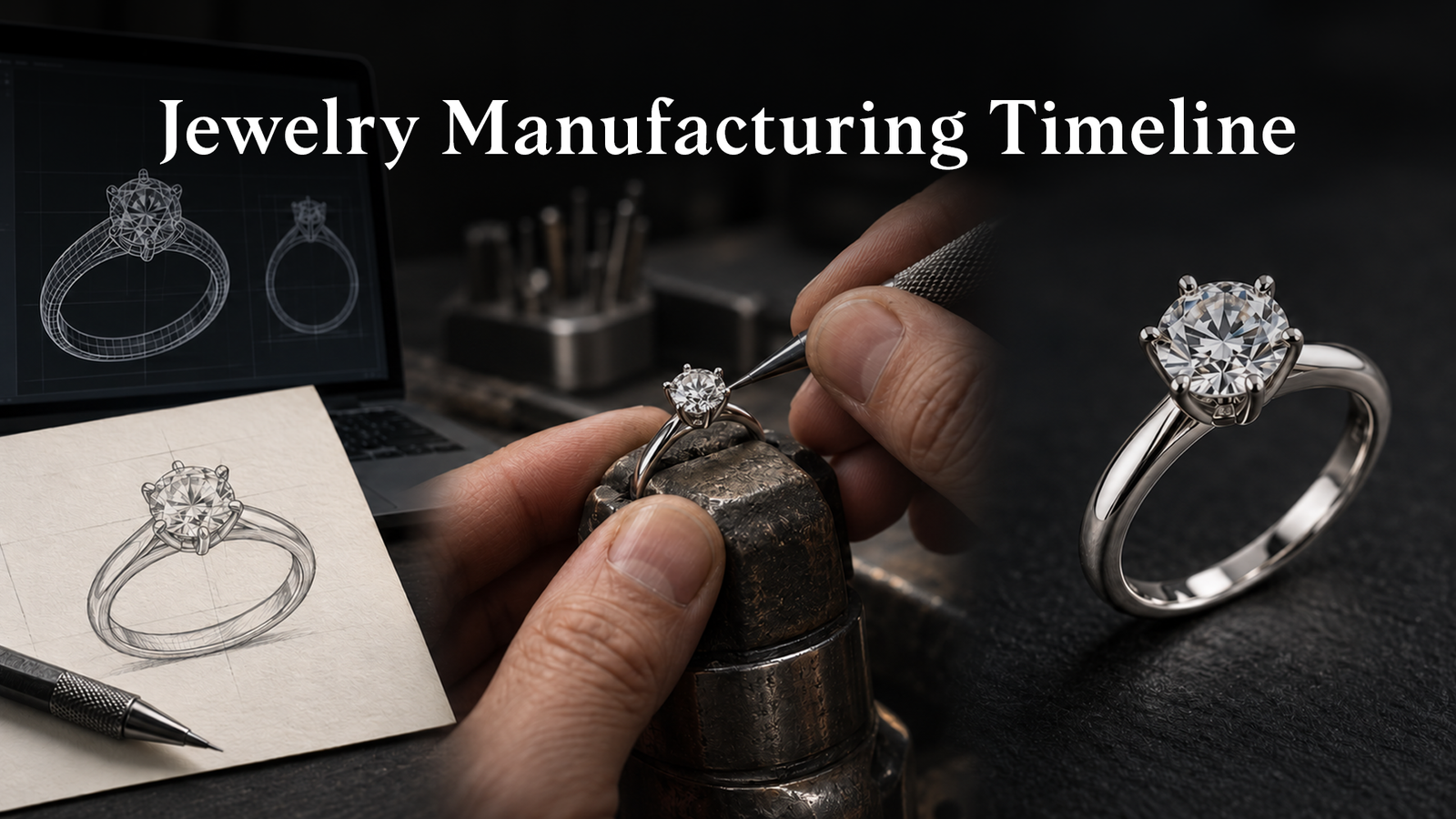
Your collection launches in March, marketing is booked, and one question decides whether it works: how long will it take to manufacture my custom jewelry order? A clear jewelry manufacturing timeline separates a calm launch from a rushed one.
There is no single answer. Design complexity, materials, sample approvals, quantity and quality checks all move the date. We manufacture custom diamond jewelry for buyers in more than 15 countries, and this guide covers each stage of a custom jewelry manufacturing timeline, from design confirmation to dispatch.
How Long Does Custom Jewelry Production Take?
Typical Jewelry Manufacturing Timeline
Timelines vary by product, customization, and order size. Treat these ranges as planning estimates, not delivery commitments.
| Production Stage | Indicative Planning Range |
|---|---|
| Design discussion and requirement confirmation | A few days to 2 weeks |
| CAD design and technical development | Several days to 2 weeks |
| Prototype or sample production | 1 to 4 weeks or more |
| Sample review and revisions | Several days to a few weeks |
| Bulk production | A few weeks to several months |
| Final quality inspection and dispatch preparation | Several days to 2 weeks |
Some stages overlap; others wait on your approval. Confirm the total after your manufacturer reviews the project.
Why Some Jewelry Orders Take Longer Than Others
Ready-to-produce designs move faster than fully custom ones, and simple bands faster than stone-heavy pieces. Large runs, special sourcing and first-time production add days; repeat orders of approved designs move quickest.
The Main Stages of the Custom Jewelry Manufacturing Process
Every jewelry production process follows this path:
Brief → CAD → Sample → Sourcing → Bulk Production → Quality Control → Dispatch
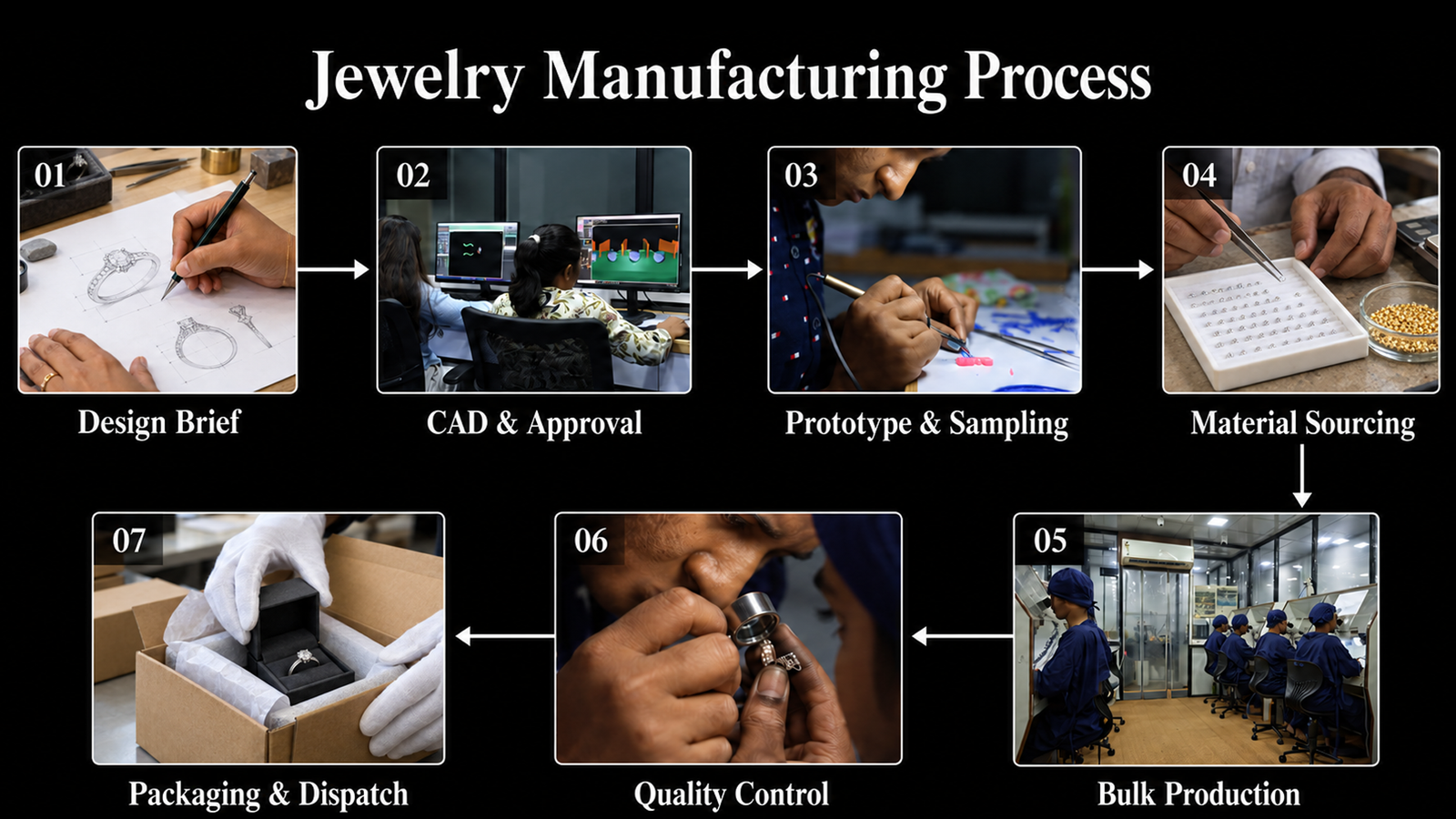
Stage 1: Design Brief and Requirements
Share sketches, references, dimensions, metal, stones, target price and quantity. Missing details trigger clarification rounds, so confirm the brief first.
Stage 2: CAD Design and Approval
CAD turns the concept into a production-ready model with exact dimensions and setting details. Each revision cycle adds time, so consolidate feedback into one round.
Stage 3: Prototype and Sampling
The custom jewelry sampling process lets you check size, comfort and stone placement before volume. Jewelry prototype development time depends on the product and, when quoted separately, sits outside the bulk production clock.
Stage 4: Material Sourcing
Metal, diamonds and findings must be ready before production. Specific stone sizes or special-order components add lead time.
Stage 5: Bulk Jewelry Production
The approved sample guides casting, stone setting, finishing and assembly. The bulk jewelry production timeline depends on volume, complexity, capacity and variations. Repeat orders run faster because specifications are set.
Stage 6: Quality Control and Final Approval
Pieces are checked for workmanship, dimensions, stone security and finish against the sample. Rework adds days, so schedule QC as a real stage.
Stage 7: Packaging, Dispatch and Delivery
Jewelry manufacturer delivery time usually means the date goods leave the factory after packing and documentation; shipping and customs transit come after it.
Key Factors Affecting Jewelry Manufacturing Lead Time
- Design Complexity and Customization: Intricate details and complex stone settings take longer than simple, repeatable designs.
- Jewelry Type and Materials: Rings, pendants, bracelets and multi-piece sets carry different workloads, and metal or gemstone availability shifts timing. No category has a fixed duration.
- Order Quantity and Production Capacity: Larger orders need more scheduling and inspection, yet doubling quantity rarely doubles jewelry manufacturing lead time; capacity and workflow matter more.
- Sample Revisions and Approval Delays: Late feedback, multiple decision-makers and changing specifications cause most jewelry production delays. Assign one decision-maker and approve in writing.
- Material Availability and Seasonal Demand: Among the factors affecting jewelry production time, sourcing constraints and peak seasons are hardest to control, so raise fixed launch dates early.
Custom Jewelry Sample Time vs Bulk Production Time
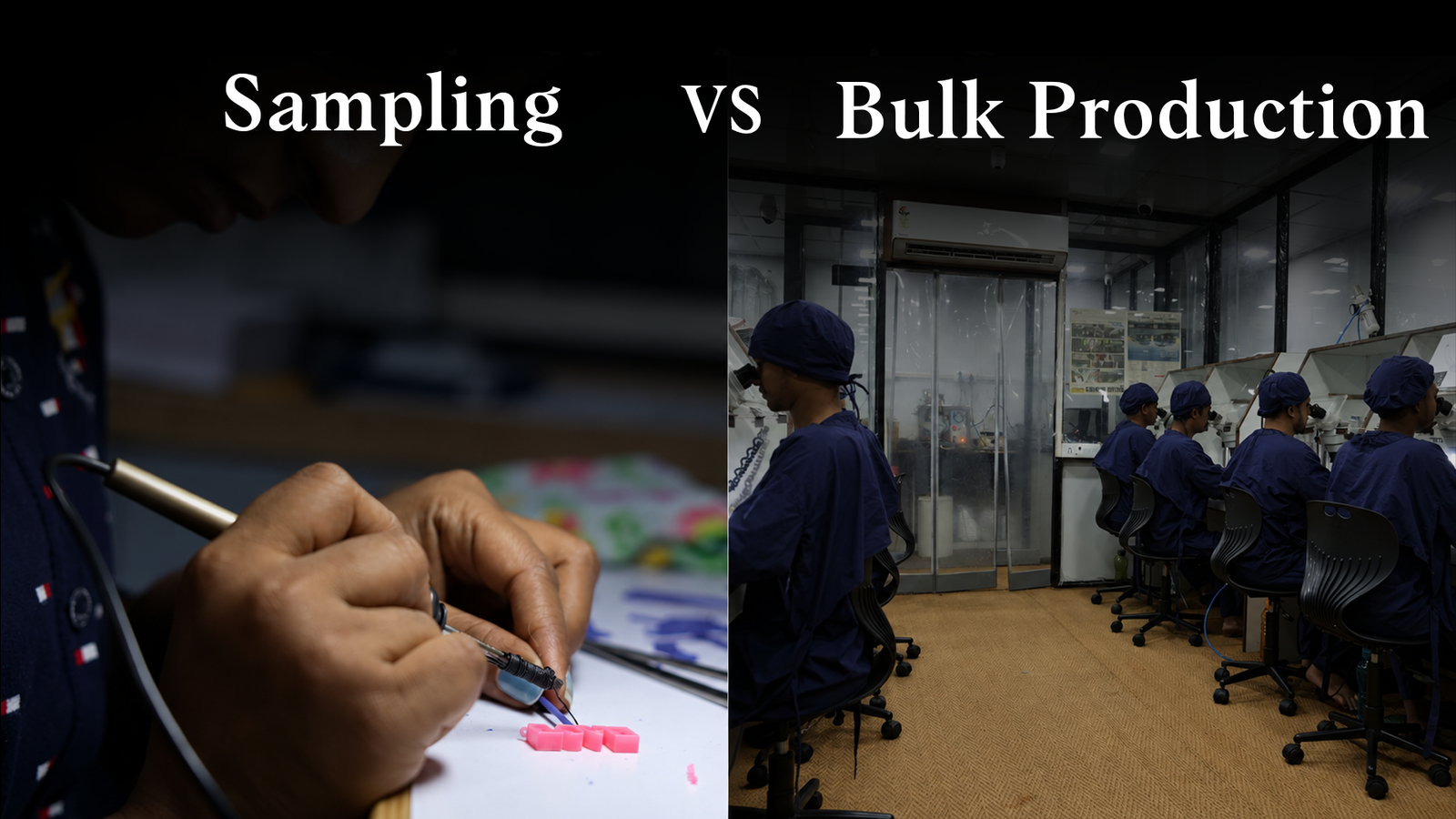
What Is the Difference Between Sampling and Mass Production?
A sample proves the design works; bulk production repeats it consistently. Sample approval does not mean materials for the full order are ready.
Does Sample Approval Guarantee On-Time Bulk Delivery?
No. Materials, capacity, order changes and inspection still affect the date. Ask for separate sampling and bulk estimates, and confirm the production start date.
How to Reduce Delays in Custom Jewelry Production
Prepare a Complete Product Brief
Send drawings, dimensions, metal and stone details, quantities, budget and compliance needs on day one.
Finalize Specifications Before Bulk Production
Lock CAD files, the approved sample, materials and variations, and record every approved change.
Set Realistic Deadlines and Approval Windows
Work backward from your in-hand date, leaving room for revisions, QC and shipping. Production completion is not delivery.
Maintain Clear Communication
Agree on milestone updates and one contact person, and ask for early warning when sourcing slips.
Jewelry Production Planning for Brands Launching a Collection
Work Backward From Your Launch Date Plan from the day products must be on sale, then subtract time for photography, packaging, marketing and inventory processing.
Build a Production Buffer Allow contingency for revisions, sourcing, shipping and customs, tailored to your project and destination.
Plan Repeat Orders and Seasonal Collections Early Share forecasts early. Reusing approved specifications usually shortens jewelry order lead time.
Questions to Ask Your Jewelry Manufacturer
- What is the estimated timeline for design, sampling and bulk production?
- When does the production clock officially start?
- Are sample development and sample shipping included in the estimate?
- What materials or approvals are required before production begins?
- How many sample revisions are included?
- What quality-control checks take place before dispatch?
- What could cause the timeline to change?
- Is shipping time included in the quoted delivery estimate?
- How will milestones and delays be communicated?
Choosing a Jewelry Manufacturing Partner Who Communicates Clearly
Why Timeline Transparency Matters Realistic estimates and proactive updates let you plan launches and inventory. A credible partner explains risks instead of promising an unrealistic custom jewelry turnaround time.
What to Look for Beyond Fast Production Look for clear approval steps, consistent quality checks, honest lead-time estimates and open communication about sourcing and capacity.
Working With D'vins Jewels
D’vins Jewels is a Surat-based partner for custom diamond jewelry manufacturing, with 10 years in B2B and in-house production. Every custom project starts with a free CAD design, usually within 24 hours. Production moves through wax, casting, diamond setting and quality checks, and we share videos of finished pieces before dispatch, with one dedicated relationship manager throughout. For an accurate timeline, send your design references, product type, quantity, materials and target delivery date.
Plan Your Jewelry Production Timeline With Confidence
Custom jewelry production time depends on design, sampling, materials, approvals, volume, QC and logistics. Separate manufacturing time from transit time and plan backward from launch. Share your requirements with D’vins Jewels, and we will send a project-specific timeline along with wholesale pricing.
Frequently Asked Questions
It depends on design, quantity and approvals. Most projects take several weeks from brief to dispatch; complex orders take longer.
Typically one to four weeks after CAD approval, depending on complexity and materials.
From a few weeks to several months, based on volume, design and materials.
Incomplete briefs, repeated revisions, late approvals, stone sourcing, rework and peak-season demand.
Usually not. Confirm whether your quote covers transit and customs or only factory dispatch.
Often, if the deadline is shared upfront and approvals stay on schedule.
Send a complete brief, consolidate feedback, approve in writing, and reuse approved designs for repeat orders.