Custom Jewelry Manufacturer vs Jewelry Supplier: Understanding the Difference
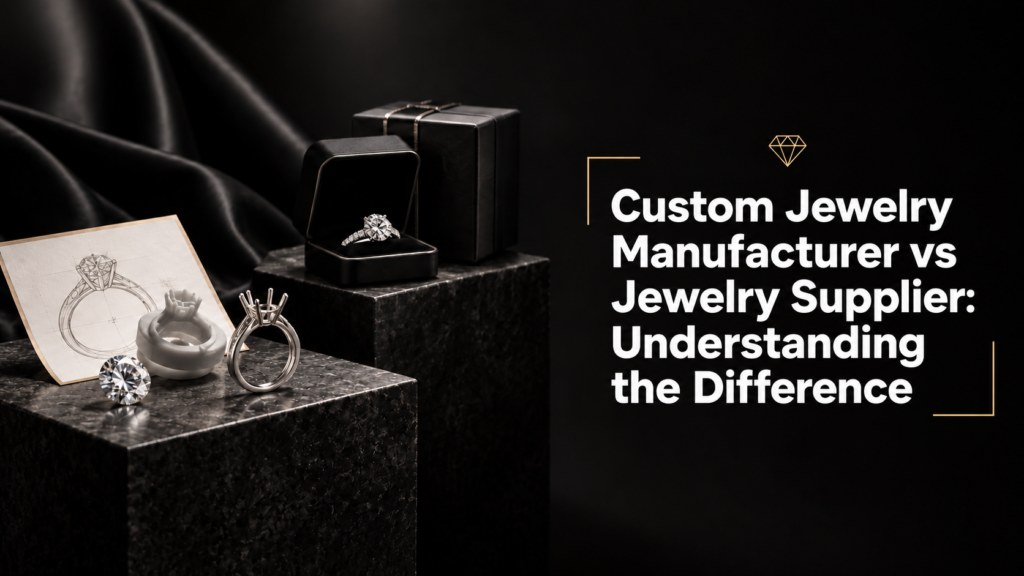
Manufacturer vs Supplier: Key Differences
The answer depends less on where you can buy jewelry and more on what you expect the business behind it to control.
Both models can deliver finished products. However, a custom jewelry manufacturer vs jewelry supplier comparison reveals important differences in design development, pricing transparency, production responsibility, repeat-order consistency, minimum order requirements, and brand exclusivity. If you need available inventory for an immediate launch, a supplier may be enough. If you need a collection developed around your specifications and reproduced consistently, you are looking for a manufacturing partner.
What Is a Custom Jewelry Manufacturer?
A custom jewelry manufacturer turns a buyer’s commercial requirement into a production-ready product. That responsibility usually covers the complete journey:
Idea → Design → CAD → Prototype → Production → Finishing → Quality Check → Final Jewelry
The process may begin with a sketch, reference image, technical brief, or target price point. The manufacturer then converts that input into a CAD model with defined dimensions, estimated metal weight, stone placement, setting details, and manufacturing tolerances.
Once approved, the design moves through prototyping, casting, filing, setting, polishing, cleaning, and inspection. The approved specifications can then be retained for repeat production. This direct involvement is what distinguishes custom jewelry manufacturing from product sourcing. It gives brands greater control over the metal, gemstones, dimensions, finish, construction, and final appearance. D’vins states that its production, finishing, and inspection are handled in-house in Surat, providing buyers with a direct link to the team responsible for manufacturing their products.
What Is a Jewelry Supplier?
A jewelry supplier primarily helps buyers source finished jewelry. Products are generally selected from an existing catalog, available inventory, or a network of third-party manufacturer.
A wholesale jewelry supplier can be useful when a retailer needs inventory quickly, an e-commerce business wants to test a product category, or a wholesaler wants to fill an immediate stock requirement. Because product development has already taken place, orders can often move faster than a custom project. Some suppliers allow changes to plating, stone colors, packaging, or branding. However, buyers should confirm whether these modifications are completed by the supplier or passed to another production facility. The supplier model is not an inferior version of manufacturing. It solves a different problem: access to available products without managing a full development cycle.
Custom Jewelry Manufacturer vs Jewelry Supplier: Key Differences
| Factor | Custom Jewelry Manufacturer | Jewelry Supplier |
|---|---|---|
| Product development | Develops products from a brief | Mainly provides existing products |
| Design control | High | Usually limited |
| CAD development | Commonly available | May not be available |
| Customization | Based on buyer specifications | Based on available options |
| Production control | Direct | May involve third parties |
| Private label suitability | Strong | Depends on capabilities |
| MOQ | Based on design and production | Based on stock or sourcing model |
| Repeat production | Uses approved specifications | Depends on continued availability |
| Brand exclusivity | Can be contractually defined | Often limited |
| Best suited for | Custom and private-label collections | Ready-to-sell inventory |
Which Model Gives You More Control?
Design Control
A manufacturer can develop or modify the shape, dimensions, metal, diamond specifications, setting style, weight, and finish. CAD approval also gives the buyer an opportunity to identify production or cost concerns before metal is cast. A supplier usually offers control within an existing product framework. If a catalog ring is available only in certain metals, stone sizes, or finishes, further changes may require external manufacturing.
Production Control
When production is handled directly, the approved specifications can follow the product through casting, setting, finishing, and quality inspection. With a supplier, buyers should determine who controls these stages. If production is outsourced, ask how technical instructions are communicated, how defects are addressed, and who is responsible when a batch differs from the approved sample.
Brand Control
A brand needs more than a good first sample. It needs to know whether the same design can remain exclusive, be reordered six months later, and retain its proportions, metal weight, stone placement, and finish. A private label jewelry manufacturer is generally better positioned to preserve these specifications and build related designs into a complete collection. A supplier’s ability to reorder may depend on catalog changes or third-party availability.
How Pricing and Margins Can Differ
A low unit price does not automatically create a better margin.
The landed cost may include metal weight, diamond or gemstone cost, labor, wastage, CAD development, sampling, certification, packaging, supplier markup, shipping, insurance, duties, and logistics.
Direct manufacturing can offer greater visibility into these components. It can also allow the buyer to adjust weight, construction, stone size, or production quantity to meet a commercial target. That does not mean manufacturer are always cheaper. Custom development, prototypes, tooling, and small production runs may increase the initial investment. Suppliers may provide better short-term value when products are already available, and no development work is required. Compare total cost against product control, consistency, exclusivity, reorder reliability, and time to market. The cheapest first order can become expensive if the product cannot be reproduced after it starts selling.
Custom Manufacturing or Ready-to-Sell Jewelry?
Choose a custom jewelry manufacturer when you are building a recognizable brand, developing original designs, creating a private-label collection, controlling technical specifications, or planning repeat production. Choose a supplier when you need available products quickly, want to test demand, do not require extensive changes, or prefer sourcing from an existing catalog.
A custom jewelry supplier may offer selected modifications to ready designs. Before placing an order, confirm whether the company manufactures those changes and whether the modified version can be reproduced later.
Which Model Fits Your Jewelry Business?
For jewelry brands, custom manufacturing is usually the stronger fit because the product must support a distinct brand identity.
Retailers can use either model. A supplier can provide seasonal or replacement inventory quickly, while a jewelry manufacturer for retailers can develop exclusive store collections.
E-commerce brands benefit from manufacturing when differentiation is important. Products taken from widely available catalogs can make price the only meaningful point of competition.
Wholesalers may use suppliers for immediate stock and manufacturer for larger, specification-led programs. Private-label businesses generally need a manufacturer because their offer depends on consistent products carrying their own identity.
Questions to Ask Before Choosing a Partner
Use these questions to test what the business can control:
- For a manufacturer: Is production handled in-house? Who owns the CAD after development? Can I approve a prototype? What tolerances are maintained between sample and bulk production? How is quality inspected? Can the same specifications be used for repeat orders? What are the MOQs? Can you manufacture under my brand and support international shipments?
- For a supplier: Are the products manufactured internally or sourced? What customization is possible? Can the same design be reordered? How stable is availability? What are the MOQs? Is private labelling supported? Where does production take place, and who resolves quality issues?
Clear answers are more useful than claims about craftsmanship or service. They reveal whether you are dealing with a production partner, a sourcing intermediary, or a combination of both.
When Should You Choose a Custom Jewelry Manufacturer?
You should choose a custom jewelry manufacturer when your business needs greater control over the product than an existing catalog can provide. This is especially relevant when you are developing original designs, building a private-label collection, or working with specific requirements for metal, gemstones, dimensions, setting styles, weight, or finish.
A manufacturer is also the better fit when repeatability and scalability matter. If a successful design must be reordered with the same proportions, stone placement, construction, and quality standards, working directly with the production team helps preserve the approved specifications across future batches. Custom manufacturing is particularly valuable for jewelry brands, retailers, wholesalers, and e-commerce businesses that want product differentiation, defined exclusivity, transparent development, and a long-term production relationship. It allows the collection to be developed around the brand’s market, price point, and commercial goals rather than being limited to available inventory.
Why D’vins Is a Manufacturing Partner
D’vins works as a custom diamond jewelry manufacturer, supporting buyers from design development through final dispatch. Its capabilities include CAD-based development, natural and lab-grown diamond jewelry, private-label manufacturing, flexible production, in-house finishing, quality inspection, and global shipping support.
The company states that it works with retailers, wholesalers, distributors, jewelry brands, and e-commerce businesses across more than 15 countries. This matters because international jewelry sourcing for brands requires more than making the first order. It requires clear specifications, reliable communication, controlled production, inspection, documentation, and the ability to reproduce successful designs.
D’vins Manufacturing Process
D’vins publicly outlines its production journey as:
Your Requirement → CAD → Wax Development → Casting → Filing → Pre-Polish → Diamond Setting → Final Polish → Cleaning → Quality Check → Dispatch
Each stage represents direct involvement in creating the product. It also demonstrates why a manufacturer can influence design feasibility, production consistency, finish, and inspection in ways that a business supplying existing products may not.
Manufacturer or Supplier: A Simple Decision Guide
Need ready-made jewelry quickly? A supplier may be suitable.
Need original designs, private labelling, exclusive collections, controlled specifications, or long-term repeat production? Work with a manufacturer.
Testing products before investing in development? Begin with a supplier.
Planning to scale a successful collection without changing its specifications? Choose a jewelry manufacturing partner capable of retaining approved CAD files, masters, and production standards.
Conclusion
A jewelry supplier helps you source products. A custom jewelry manufacturer helps you develop products around your brand’s requirements. The right model depends on your priorities. Suppliers provide speed and access to available inventory. Manufacturer provide deeper control over design, production, quality, repeatability, and exclusivity. For brands, retailers, wholesalers, and private-label businesses planning long-term growth, the right manufacturing relationship can become part of the business infrastructure not merely another source of jewelry. Share your design brief, target market, quantities, and product specifications with D’vins to discuss a manufacturing approach for your next collection.
Frequently Asked Questions
A manufacturer develops and produces jewelry, while a supplier mainly sources and provides finished products. Some companies perform both roles, so buyers should confirm which processes are handled directly.
It is generally better when you need custom designs, private labelling, controlled specifications, or repeat production. A supplier may be more practical for quick access to existing products.
Not necessarily. Costs depend on materials, volume, customization, development, labour, markup, and logistics. Compare total landed cost and long-term value rather than only the unit price.
Yes. A capable manufacturer can convert your brief into CAD, develop a prototype, manufacture the approved product, and retain its specifications for future production.
A private-label manufacturer produces jewelry under the buyer’s brand and agreed specifications. A supplier may add branding to existing products without developing a distinct collection.
Brands seeking differentiation and repeatable collections generally benefit from a manufacturer. Businesses testing ready-made products may find a supplier more suitable.
Evaluate in-house capabilities, CAD ownership, prototyping, quality controls, tolerances, MOQs, repeat-order systems, private-label support, export experience, communication, and shipping arrangements.