
Private-label jewelry manufacturing process featuring diamond jewelry, production trays, quality inspection, and custom packaging for growing jewelry brands

A jewelry brand may have a strong concept, clear aesthetic, and defined customer, but converting that idea into consistent, sellable products requires reliable production. Private label jewelry manufacturing allows brands to create jewelry under their own identity without investing in machinery, skilled production teams, or a dedicated factory. This guide explains how private labeling works, what it costs, how MOQs affect new businesses, and what brands should check before selecting a manufacturing partner.

What Is Private Label Jewelry Manufacturing?

Private label manufacturing means a specialist manufacturer produces jewelry that another business sells under its own brand.

Your Brand → Product Concept → Manufacturer → Finished Jewelry → Your Brand Name

Unlike generic wholesale jewelry, private-label products can be developed around specific materials, dimensions, stone grades, finishes, and packaging. The process may use adapted manufacturer designs or brand-led concepts. Fully custom manufacturing usually starts with an original design and requires deeper development. Private labeling can offer a balance between customization, development time, and production efficiency.

Why Emerging Jewelry Brands Choose Private Label Manufacturing

Starting a factory requires equipment, trained craftspeople, material sourcing, production systems, and quality-control expertise. A jewelry manufacturer for emerging brands provides access to these capabilities without the same operational investment. Private labeling helps brands build a recognizable identity, create collections for a defined customer, test products, maintain repeatable specifications, and increase production when demand grows. It is not simply about adding a logo to an available product. A capable manufacturer helps define the construction, metal, stones, weight, finish, and quality standards behind the brand name.

Private Label vs Custom vs Wholesale Jewelry

Factor Private Label Custom Manufacturing Wholesale
Brand identity High Very high Limited
Customization Moderate to high Very high Usually limited
Existing designs Possible Usually no Usually yes
Development Brand and manufacturer Brand and manufacturer Mainly supplier
Exclusivity Can be arranged Strong Usually limited
Best for Emerging brands Original collections Ready inventory
Wholesale is useful for quick inventory or product testing. Private labeling suits brands needing differentiation and repeat production. Custom manufacturing is generally better when originality and design ownership are central to the business. needs?”

What Private Label Jewelry Manufacturing Works

The usual production journey is:

Brand Concept → Design Selection or Development → CAD → Prototype → Approval → Production → Diamond Setting → Finishing → Quality Check → Packaging → Dispatch

The brand defines its customer, product category, target price, materials, aesthetic, and quantity. The manufacturer converts these requirements into production-ready specifications. Both parties approve the design and sample before bulk production begins.

Private Label Jewelry Manufacturing Process: Stage by Stage

1. Brand Brief and Product Requirements
  • What happens: Product specifications are documented.
  • Brand provides: References, quantities, target price, and customer profile.
  • What can go wrong: An unclear brief creates inconsistent results.
  • Brand should check: Metal, stones, weight, sizes, and finish.
  • D’VINS approach: Development is guided by confirmed buyer requirements.
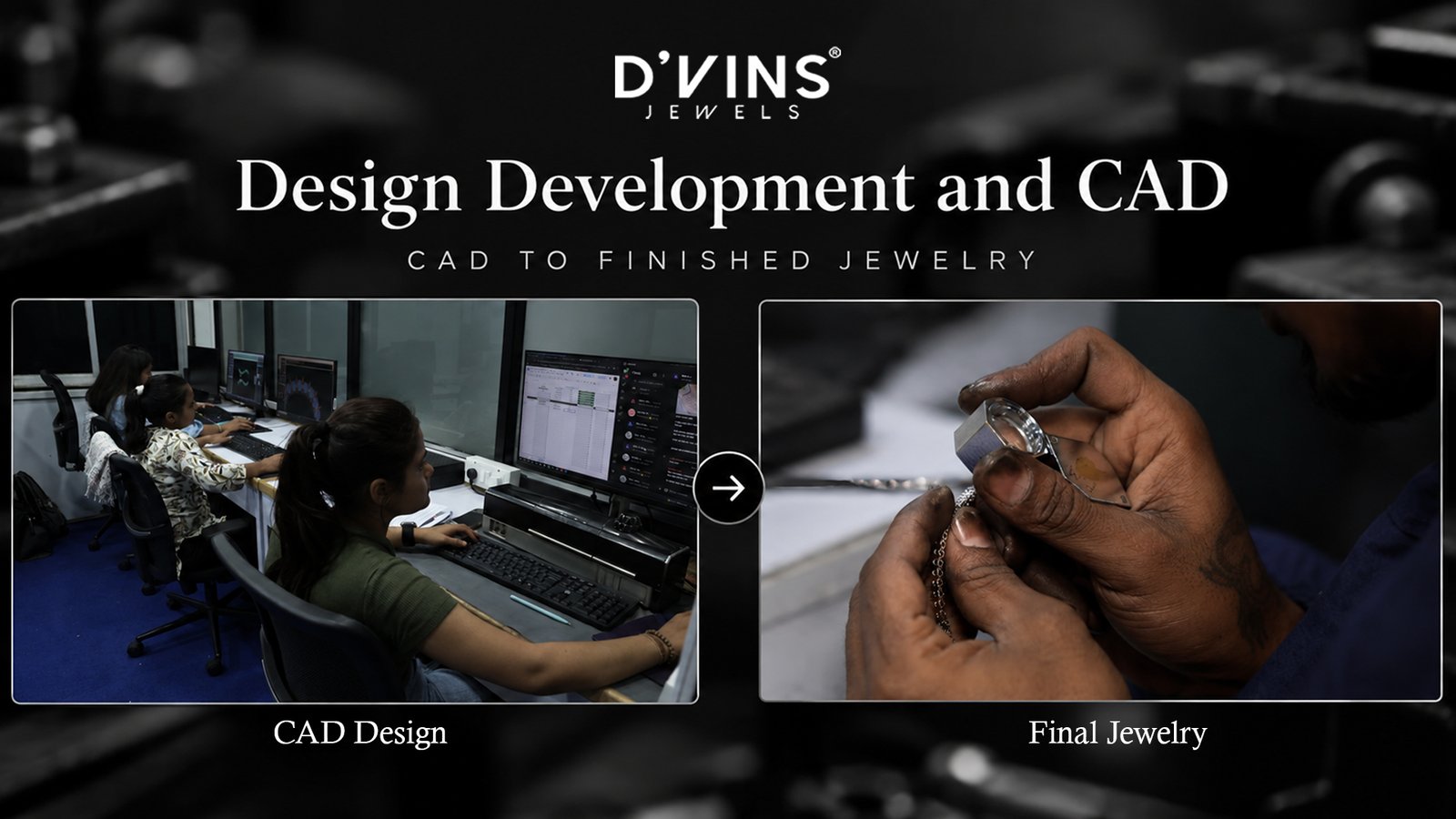
2. Design Development and CAD Jewelry design development and CAD to finished jewelry showing CAD design and final jewelry
  • What happens: The concept becomes a dimensioned 3D model.
  • Brand provides: Design direction and required measurements.
  • What can go wrong: A visually appealing design may not be production-ready.
  • Brand should check: Dimensions, stone placement, weight, and wearability.
  • D’VINS approach: CAD development is included in its custom jewelry process.
3. Prototype or Sample Development
  • What happens: A physical sample is created.
  • Brand provides: CAD approval and sample instructions.
  • What can go wrong: Skipping sampling allows sizing or proportion problems into production.
  • Brand should check: Comfort, scale, weight, and finish.
  • D’VINS approach: Sampling supports approval before production quantities are confirmed.
4. Material and Diamond Selection
  • What happens: Metal purity, diamond type, grades, and stone sizes are finalized.
  • Brand provides: Quality expectations and budget.
  • What can go wrong: Vague descriptions create specification disputes.
  • Brand should check: Written metal and stone details.
  • D’VINS approach: Natural and lab-grown diamond options are available.
5. Casting and Production
  • What happens: Approved designs move through casting, filing, and assembly.
  • Brand provides: Final quantities and size variations.
  • What can go wrong: Porosity or weight variation may affect quality and cost.
  • Brand should check: Sample-to-production consistency.
  • D’VINS approach: Casting, filing, and pre-polish form defined production stages.
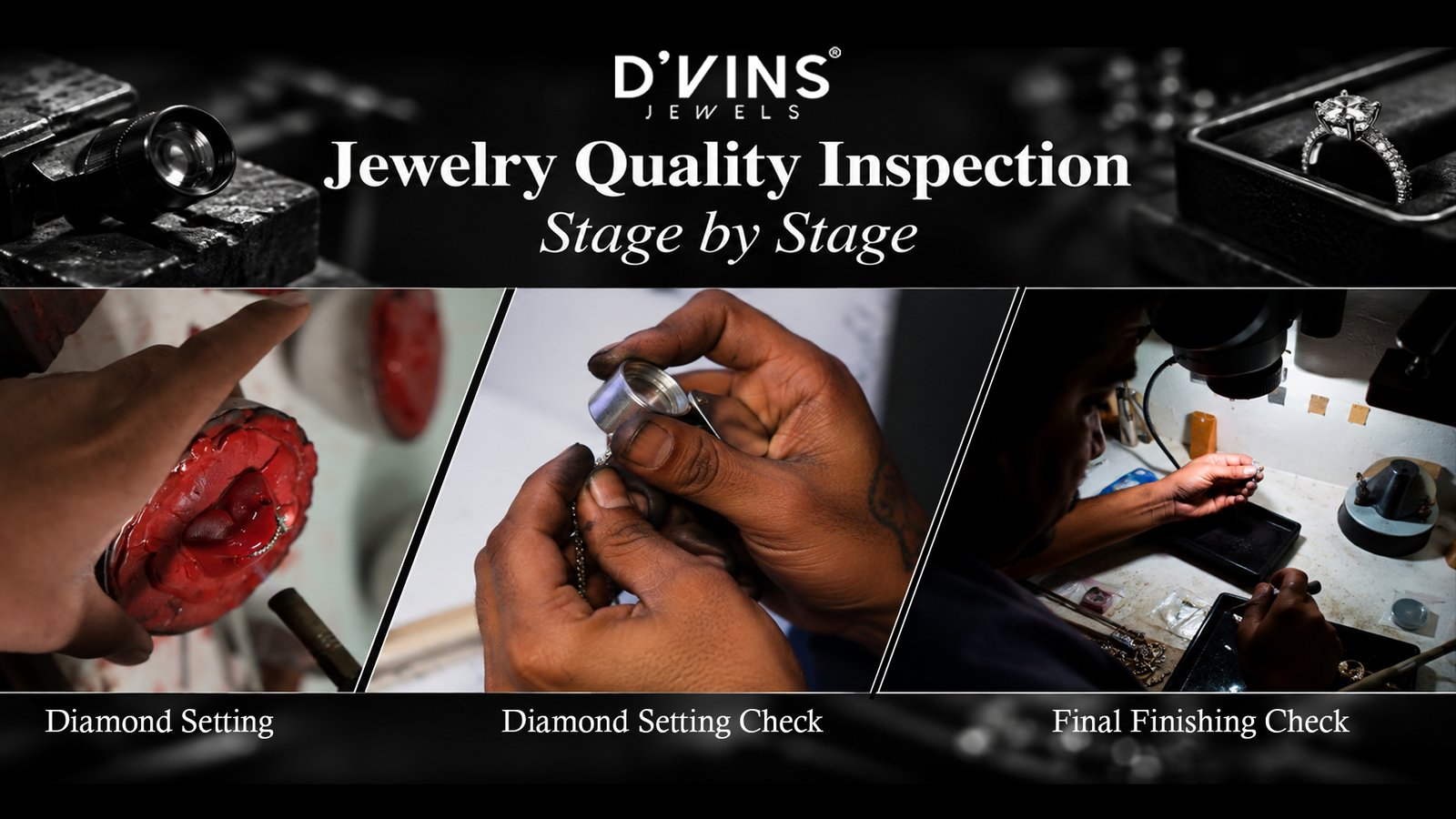
6. Diamond Setting
  • What happens: Stones are positioned and secured.
  • Brand provides: Approved setting and stone specifications.
  • What can go wrong: Loose or misaligned stones can cause returns.
  • Brand should check: Setting security and alignment.
  • D’VINS approach: Setting is followed by further finishing and inspection.
7. Polishing and Finishing
  • What happens: Surfaces are refined, polished, cleaned, or plated.
  • Brand provides: An approved finish reference.
  • What can go wrong: Excess polishing may reduce weight or soften details.
  • Brand should check: Several pieces against the sample.
  • D’VINS approach: pre-polish, final polish, and cleaning are separate stages.
8. Quality Inspection
  • What happens: Finished pieces are checked against specifications.
  • Brand provides: Approved standards and tolerances.
  • What can go wrong: Visual inspection alone may miss sizing, weight, or setting issues.
  • Brand should check: Actual QC checkpoints.
  • D’VINS approach: Quality inspection takes place before dispatch.
9. Packaging and Dispatch
  • What happens: Products are counted, protected, documented, and shipped.
  • Brand provides: Packaging and delivery instructions.
  • What can go wrong: Packing or paperwork errors can delay delivery.
  • Brand should check: Counts, insurance, documentation, and tracking.
  • D’VINS approach: Its process supports domestic and international dispatch.
How to Choose a Private Label Jewelry Manufacturer

Assess manufacturing experience, CAD and prototyping capabilities, in-house production, diamond expertise, quality control, MOQ flexibility, capacity, communication, international shipping, and repeat-order support. Ask how approved CAD files, master samples, measurements, stone details, and finishing references are stored. A successful product has limited value if the next order cannot match it.

Brands searching for a private label jewelry manufacturer USA buyers can work with should not judge location alone. An overseas manufacturer may be suitable if it understands export documentation, delivery planning, international quality expectations, and clear communication.

What Should Emerging Brands Know About MOQ?

MOQ is the minimum quantity a manufacturer accepts for production. It exists because CAD, sourcing, casting setup, labor planning, and inspection create costs even for smaller orders. A high MOQ can lock a startup’s budget into untested stock. Small-batch production may cost more per piece but reduces inventory risk. Once sales identify the strongest designs, those products can move into larger runs. Ask for MOQ per design because requirements may vary by metal, stones, complexity, and customization. D’VINS’ MOQ should be confirmed against the specific project.

Understanding Private Label Jewelry Costs

The cost of custom private label jewelry depends on metal type and weight, diamond quality, gemstones, labor, complexity, quantity, certification, packaging, and shipping. Request quotations using the same written specifications. Otherwise, a cheaper quote may be based on lower weight, different stone quality, or fewer production controls. The cheapest quote is not always the lowest total cost. Rework, loose stones, inconsistent sizes, delays, and unreliable reorders can cost more than the initial price difference.

Quality Control in Private Label Jewelry Manufacturing

Quality control protects the brand whose name appears on the product. Checks should cover CAD accuracy, prototype approval, metal and weight, diamond quality, setting security, dimensions, surface finishing, polish consistency, and final order quantities. Instead of accepting claims such as “premium quality,” ask when inspections occur, what is checked, and what happens when a piece fails.

Private Label Jewelry for Different Types of Brands

New startups benefit from focused collections, manageable quantities, and product testing. DTC and e-commerce brands need consistent SKUs, differentiation, and dependable reorders. Retail brands require collection consistency, replenishment, and capacity for larger production. Boutique and luxury brands may need deeper customization, selected materials, specialist craftsmanship, and stronger exclusivity. The right private label jewelry for brands depends on the customer, sales model, price positioning, and growth stage.

How to Build Your First Private Label Jewelry Collection

Define the customer first, then choose a focused category and establish a consistent design language. Select products, create samples, test customer response, refine weaker designs, begin controlled production, and reorder proven sellers. A first collection does not need dozens of pieces. Products should be selected according to customer needs, target pricing, wearability, and sales potential. Reorders should be guided by sales velocity, margins, returns, reviews, and customer enquiries.

Common Private Label Jewelry Manufacturing Mistakes

Common mistakes include selecting a manufacturer only on price, ordering large quantities before testing, skipping sample approval, leaving diamond specifications unclear, relying on verbal instructions, overlooking repeat-order consistency, ignoring production capacity, and treating packaging or deadlines as secondary concerns. Brands should plan for the third order, not only the first. Approved designs must be stored and reproduced without gradual changes in weight, proportions, stones, or finish.

Why D’VINS for Private Label Jewelry Manufacturing?

D’VINS supports jewelry brands, retailers, wholesalers, distributors, and e-commerce businesses. Its published capabilities include private-label manufacturing, custom jewelry development, CAD, sampling, natural and lab-grown diamond jewelry, in-house production, finishing, quality inspection, and international shipping support.

Its manufacturing journey covers requirements, CAD, wax development, casting, filing, pre-polish, diamond setting, final polish, cleaning, quality checking, and dispatch. This structured process supports consistency from initial approval through repeat production.

Private Label Jewelry Manufacturer Buyer Checklist

Before choosing a private label jewelry supplier, ask:

  • Do you specialize in private-label jewelry?
  • Can you develop or modify custom designs?
  • Which production stages are handled in-house?
  • Do you provide CAD and prototype approval?
  • What is the MOQ per design?
  • Can you support small-batch production?
  • How are specifications retained for repeat orders?
  • What quality checks are performed?
  • Can you work with natural and lab-grown diamonds?
  • Can you support international shipping?
  • Can production scale with my brand?
  • Is private-label packaging support available?

Conclusion

Private label jewelry manufacturing enables brands to turn a product concept into a scalable collection without building their own manufacturing infrastructure. The right partner should provide more than production. It should offer design support, documented specifications, quality control, consistent reorders, clear communication, and capacity for growth. Share your collection concept, design requirements, expected quantity, target price, and sales market with D’VINS to discuss a suitable manufacturing approach.

Frequently Asked Questions

1. What is private label jewelry manufacturing?

It is the production of jewelry by a manufacturer for sale under another company’s brand and approved specifications.

2. How does private label jewelry manufacturing work?

The brand provides its requirements, approves designs and samples, and authorizes production. The manufacturer manages development, manufacturing, inspection, and dispatch.

3. How much does it cost to start a private label jewelry brand?

Costs depend on materials, design count, sampling, quantity, customization, packaging, shipping, marketing, and inventory requirements.

4. What is the minimum order quantity for private label jewelry?

MOQ is the smallest quantity accepted for production. It varies according to the design, metal, stones, and customization.

5. What is the difference between private label and custom jewelry manufacturing?

Private labeling may adapt existing designs, while custom manufacturing generally begins with an original concept requiring complete product development.

6. How do I find the right private label jewelry manufacturer?

Compare production capabilities, CAD support, sampling, quality controls, MOQs, repeat-order systems, export experience, and communication.

7. Can a private label manufacturer help an emerging brand scale?

Yes. The right manufacturer can test initial products, retain approved specifications, reproduce bestsellers, and increase quantities as demand grows.